
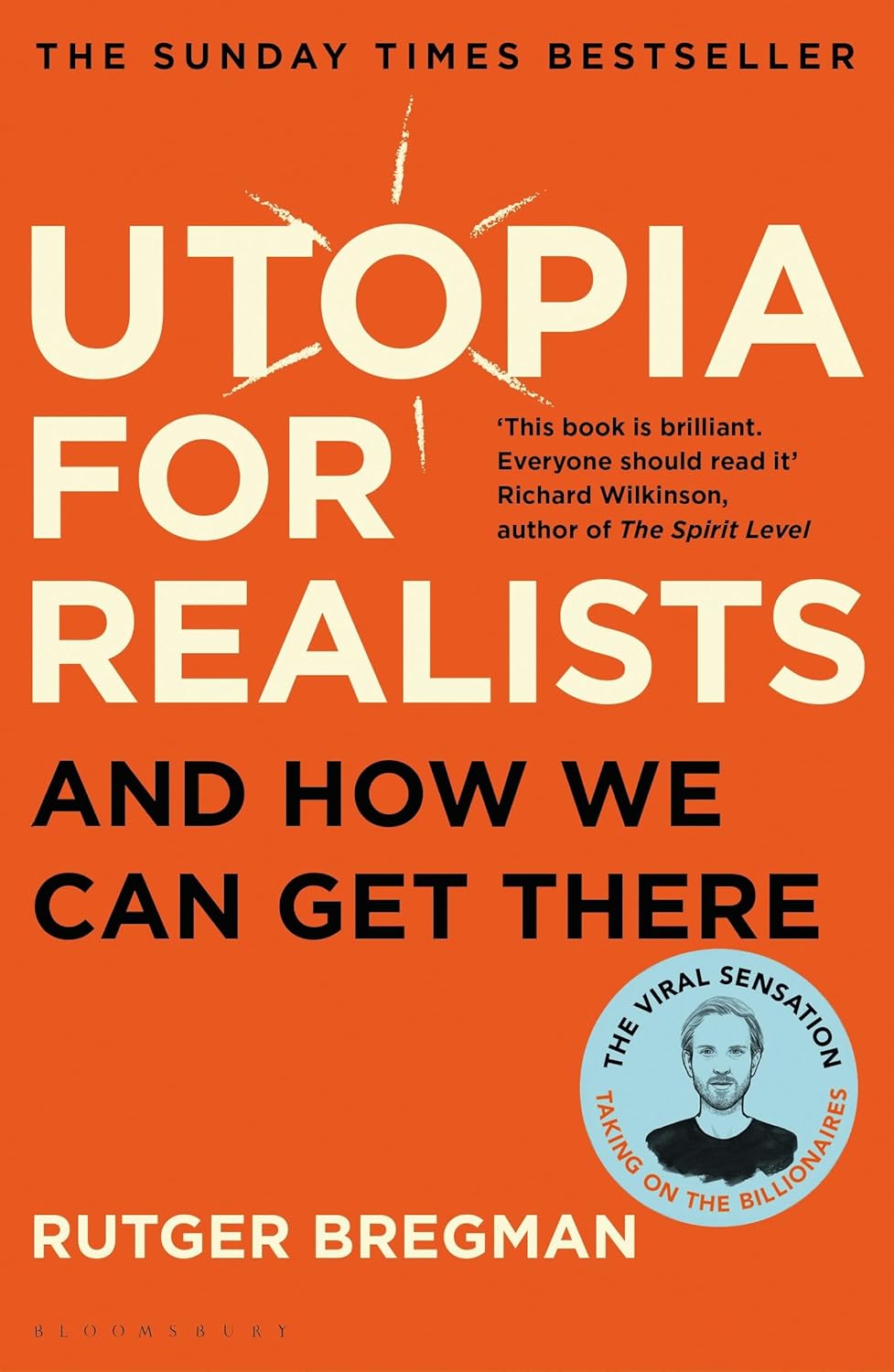
# books / Utopia for Realists - Rutger Bregman
Less utopian, more evidence-based-and-undeniable, the world outlined by Bregman has a change in political mindset as much as a change in policy.
It feels both within grasp and, in light of the political realities, highly unlikely.
What’s a “Realist”?
As well as the policy changes for which Bregman advocates, the meta-argument he makes throughout the book is that policy decisions today are made on the basis of assumption (or prejudice) and ideology.
A realist is a decision maker grounded in evidence & imperical data. Bregman outines each of his cases in this way, highlighting how some of our most strongly held political beliefs don’t stand up to reality.
Policy decisions don’t need to be all-or-nothing, or stabs in the dark. Randomised control studies are the basis of the scientific method that has brought us all of the ever-accelerating progress we see today, and is conducted in a breadth of industries to inform decision making. It’s about time top-level political decisions worked the same way.
Utopia Step 1: Universal Basic Income
What’s UBI?
Universal Basic Income is the proposition that everyone receives a minimum amount of money from the government. It would ensure a minimum standard of living, and bring everyone above the poverty line.
A floor not a hand out
The key is that there’s no qualification. It is not tested based on income or anything else. Everybody receieves the pay-out. Everyone benefits.
It’s not a hand out. It’s raising the floor. Very Rawls-ian.
Prevailing Neoliberal View
This is not a new idea, but it’s extremely politically controversial.
Pre-Existing Political Assumptions:
- “This would make people lazy & not work.”
- “This would be too expensive.”
- “People would have too many children.”
Reality: Repeated studies have shown this is not true.
What the evidence suggests
Studies have shown that from homeless people to entire Canadian towns, a guaranteed minimum income lifted people out of poverty with a lasting effect, without reducing the amount people work, the size of families. Indeed, it improved education rates, both of adults and children, reduced crime, truancy & even teen pregnancy rates.
Poverty is not caused by a lack of will, grit or character. Poverty is caused by a lack of money.
The Cost of Policing
In the West we tend to prefer qualification for “welfare” payments. There are entry criteria, for example being unemployed. Once you’re in there are continuous conditions, for example that you’re actively seeking employment. The bureaucracy that polices this is complex & expensive.
We can take the same tack on foreign aid too. Rather than setting up complex development teams that cost millions of pounds, go to developing countries, and get little done, we can just give money directly to the poor in developing countries. After all, the people in those situations know best what they need. Indeed this is what the charity Give Directly do, with proven results.
Rory Stewart, former President of GiveDirectly tells the story of a large UN initiative to provide toilets to a school in a developing nation. When he showed up there was a fleet of fancy cars and a grouping of important-looking people:
- Stewart: “What have we achieved?”
- UN Person: “We’ve installed 1 toilet and we have 2 buckets.”
- Stewart: “We’ve spent hundreds of thousands of dollars and that’s all we’ve done?”
- UN Person: “Yes”
- Stewart: “We could’ve given the teacher at this school a handful of dollars and they could’ve achieved the same.”
- UN Person: “Well they might have stolen the money.”
- Stewart: Looks around at all the people here costing thousands of dollars per hour
- Stewart: “We’ve stolen the money!!”
Anywhere you find poor people you also find non poor people theorizing their cultural inferiority and dysfunction. – Matt Bruenig
Trusting people to know what to do with their money is more efficient, and shown to boost economic performance over longer time horizons.
Utopia Step 2: More Lesiure Time
As our wealth grows we can either spend more, or work less. Today we work more than 100 years ago, suggesting we chose the “more stuff” route.
Working to the Bone
Unemployment is scorned, but doesn’t it mean we’re achieving more with fewer people? Greater efficiency. We see work as an undeniable virtue, but it’s not clear why more has to be better.
Shouldn’t this be what capitalism is striving for? More with less.
Increased Productivity
We inherited the arbitrary 5-day working week from Henry Ford, chosen for his own commercial benefit. Today it is seen as gospel.
Numerous studies have shown that working fewer hours per week actually increases productivity, thanks to increased rest & focus.
Concentration of Output
A truth of technology over history is that we can do more with fewer people. In the 1600s most people worked in Agriculture. By the end of the 1700s very few people did, yet nobody starved. Increased efficiency.
Today computing advances risk making more and more people jobless, as we can get more done with fewer humans. Kodak employed hundreds of thousands of people. Instagram employed just 13 people when they were bought for $1 billion.
Needing fewer working hours is progress. Unemployment and leisure mean increased productivity.
Concentration of Wealth
A consequence of concentrated work is concentrated wealth. Compare all of Kodak’s workforce vs the 13 people that shared Instagram’s billion.
Doing more with less means fewer people get the money. One more reason that Universal Basic Income is inevitable.
Utopia Step 3: A Better Measure of Progress
Gross Domestic Product (GDP) is perhaps the key measure used to assess the prosperity and relative progress of nations and regions.
It measures the “size of the pie”, the sum of goods and services flowing through an economy in a given period. In short, the $-value of a country.
“It’s the economy stupid”
This political quip sums up what politicians think everyone cares about: money. However most policy focuses on “growth” which drastically & disproportionately benefits those that already have most of the wealth. Beyond a certain point aggregate national wealth is no longer the most impactful inidicator of satisfaction or sense of wellbeing. Inequality is a much sharper measure of these things, and rich countries with large GDPs tend to be the worst offenders in equality terms.
Inequality has been linked to drug abuse, numerous health issues and even voter disenfranchisement.
Easy to measure vs Worth measuring
Total money is an easy measure though, and easy measures are often favoured over important measures.
GDP ignores externalities, for example harms to health, wellbeing and the environment. This rewards growth at the expense of the planet, or ourselves.
There are positive externalities which are ignored too:
- Pumping oil out of the ground: Great for GDP.
- Volunteering to help the elderly: No movement for GDP.
Value != Price.
for every pound earned by advertising executives, they destroy an equivalent of seven pounds in the form of stress, overconsumption, pollution and debt
To change our priorities we need new measures, new indicators of our progress.
What gets measure gets managed. – Peter Drucker
Bregman suggests metrics including equality distributions, environmentally sustainable growth, and happiness indexes.
Thoughts
As I write this, we stand at a critical junction. Artificial intelligence promises to change everything about our world, in no time at all. It threatens to automate every part of our economy. When all work is done by machines, owned by a select few, concentrating the spoils of economic output into the hands of this tiny minority, how will we treat everyone else?
Will the unemployed, that is virtually everyone, still be demarked useless & cast aside? Or can we recognise leisure as the intent of an efficient system?
Can we let go of our Cromwellian view of work as an unqualified virtue, and accept that redistribution will be the only way to maintain a dignified civilisation, in a world where humans have little economic purpose?
Can we learn to measure & appreciate humans for their value, not their price? To see them as more than an economic commodity?
If we cannot, then we should expect a coming age of digital serfdom.
The inability to imagine a world in which things are different is evidence only of a poor imagination, not of the impossibility of change.